
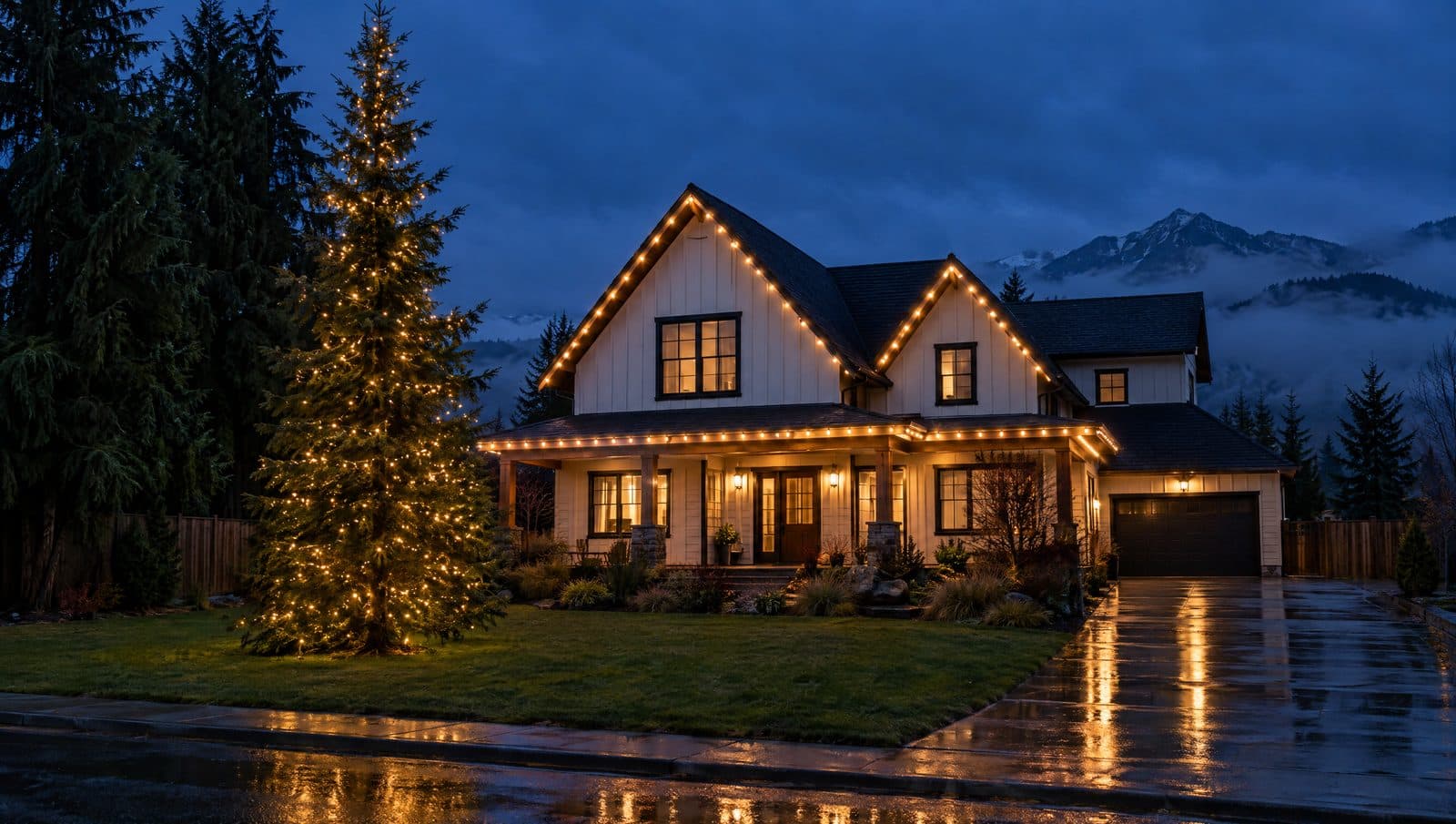
Drive any Eastside neighborhood in mid-December and you'll see it. One house looks like it belongs in a magazine. Two doors down, the next one looks like a tangle someone gave up on halfway.
Here's what surprises people. The magazine house usually doesn't have more lights. It often has fewer. The difference is design, not budget.
If you've put real care into your home and you want the lights to match, this guide is for you. You've probably stood in the driveway with a strand in your hand, unsure whether to trace the peaks or run the eaves straight. That's a design question, and it has a good answer for your style of house.
Three Rules That Work on Any House
Before we get to styles, three rules do most of the heavy lifting.
Follow the architecture. Every house has a few lines that define it. Light those and the house reads clearly from the street. Put lights on everything and it turns to noise.
Pick one color story. Warm white, cool white, or multicolor. Mixing them on one house almost always looks accidental.
Choose one focal point beyond the roofline. A lit entry, a pair of columns, or one tree. One. The eye needs somewhere to land.
Warm white vs. multicolor
Warm white has a soft, golden tone. It flatters wood, stone, cedar shingles, and deep paint colors, which describes a lot of Eastside homes. In photos, it looks calm and expensive.
Multicolor is pure fun and pure nostalgia. It works best on simpler houses where the colors can be the star, and it's a great pick if the kids get a vote.
Cool white reads crisp and modern but can look icy against warm wood.
C9 vs. mini lights
C9 bulbs are the big, classic bulbs. They read clearly from the street and from across a cul-de-sac, so they own the roofline. Mini lights are small and fine. They shine up close, wrapped around a railing, a tree trunk, or porch posts you walk past. A common mistake is running minis on a tall roofline, where they disappear from the curb.
Peaks vs. straight eaves
Tracing peaks shows off gables and makes a house feel taller. Running only the straight eaves feels calmer and works better on long, low homes. You don't have to do both. Plenty of the best-looking houses pick one.
Your Home Style, Lit Right
Start with the table, then find your style below.
| Home style | Light this | Skip or go easy on | Color story |
|---|---|---|---|
| PNW contemporary | One long eave line, entry | Busy peaks, colored bulbs on cedar | Warm white |
| Craftsman | Gables, porch columns | Wrapping every beam | Warm white or classic multicolor |
| Modern farmhouse | Steep gables, porch line | Mixed colors against black trim | Warm white |
| Two-story traditional | Front roofline and garage peak | Side and back lines nobody sees | Your call, keep it to one |
| Cedar shake roof | Gutter line only | Anything attached to the shakes | Warm white |
| Lakefront | Water-facing roofline, one tree | Heavy yard displays | Warm white |
Pacific Northwest contemporary
Low-slope roofs, big windows, cedar accents. These homes are about clean horizontal lines, so honor them. One crisp run of warm white along the main eave, plus a lit entry, usually looks best. The windows will glow from inside and do half the work for you.
Craftsman
Gables, tapered porch columns, and deep eaves. Trace the front gables and light the porch columns. Craftsmans are also one of the few styles where classic multicolor C9s look right at home, since they lean nostalgic anyway.
Modern farmhouse
Board-and-batten, steep gables, black trim. This style was made for warm white outlining the peaks. The steep lines and dark trim make a bright gable outline pop from a block away. Keep it to one color, and let the porch line be your second layer.
Two-story traditional in master-planned neighborhoods
Think of the homes in Klahanie in Sammamish or Talus in Issaquah. The front elevation does all the talking here. Put your budget where people actually look: the front roofline and the peak over the garage. Side and back lines rarely show from the street.
If you live in an HOA community, check your CC&Rs before you plan. Rules vary, and we can't speak for your HOA, but it's worth a five-minute look.
Cedar shake roofs
Cedar shakes are beautiful and they deserve gentle handling. We clip to the gutter line and never attach anything to the shakes themselves. A single warm white line along the gutter flatters the wood without risking it.
Lakefront homes
Water doubles your lights. The reflection on a calm night means every bulb shows up twice, so restraint pays off. More on that below.
Let's design it together
Licensed, Bonded, and Insured · 100% satisfaction guarantee · We guarantee our work
Designing Under Firs and on the Water
This is where national design guides fall apart. Eastside homes live under big trees and next to a lot of water, and both change the rules.
Heavy fir canopy: clean roofline, one lit tree
In tree-heavy neighborhoods like Bridle Trails in Bellevue or Klahanie in Sammamish, the firs around your house are tall and dark. They swallow scattered lights. Ten bushes lit with mini lights under towering Douglas firs look like a few stray sparkles.
What works is contrast. Run a clean, bright roofline, then light one tree near the house, ideally one you can see from the street. That single lit tree against a wall of dark firs looks intentional and calm. Less really is more under the canopy.
Lake homes: keep it warm and simple
On Pine Lake in Sammamish, Lake Meridian in Covington and Kent, or along Lake Washington in Kennydale in Renton, still water acts like a mirror. A warm white roofline turns into two lines, one on the house and one in the water.
That doubling is a gift, and it's also why busy designs look chaotic on lake homes. Multicolor reflections smear together on rippling water. Warm white stays clean. Light the side of the house that faces the water, add one tree if you like, and let the lake do the rest.
Rain-Proof Design: Why Materials Matter Here
A design only looks good if it survives the season. Eastside winters bring atmospheric rivers, fall windstorms, and weeks of steady rain. That's hard on lights.
Big-box strands come in fixed lengths with plug connections along the way. Each one is another spot for water to get in and another place a strand can go dark mid-December.
Our installs use commercial-grade C9 bulbs on wire cut to the exact length of your roofline. Fewer extra connections, no leftover strand coiled at a corner, and clean ends at every edge. Each bulb clips on, with no nails or staples in your roof or gutters, so the design holds its line through wind and rain without opening new holes. Takedown after the season is included.
When to Start Planning
Design takes a short conversation, and the calendar fills fast. We install September through January, and dates before Thanksgiving go first every year. Starting in October gives us time to walk the house with you, settle on a plan, and hang it in drier weather. You switch it on whenever you're ready.
Most single-family homes run $1,500 to $2,500. Larger and estate homes with long rooflines, multiple peaks, or extras like trees and columns run $5,000 or more. Lighting jobs take a 50% deposit to hold your date.
"Won't a Design Talk Turn Into an Upsell?"
Fair question. You might expect a lighting company to tell you to light every bush, every tree, and every window.
We tend to do the opposite. As you've read, the best-looking Eastside homes often use fewer lights, placed well. If one clean roofline and a lit tree is the right answer for your house, that's what we'll tell you.
And you're covered either way:
- Licensed, Bonded, and Insured
- 100% satisfaction guarantee. We guarantee our work. If a line isn't straight or a section looks off, we come back and fix it.
- 5.0 on Google
None of our reviews are for lighting yet. They come from cleaning jobs. This one describes how we approach any part of a house, rooflines included.
★★★★★
“They don't rush, they don't overlook anything, and they go to great lengths to make sure every brick is cleaned safely and thoroughly.”
Get a design and price in one visit
Licensed, Bonded, and Insured · 100% satisfaction guarantee · We guarantee our work
Custom, Not Cluttered
So here's where you are. You care how your house looks, and you want the lights to match it. You've seen the magazine house and the tangle, and you know which one you'd rather be. The style of your home already holds the answer.
That's right. Follow the lines, pick one color, choose one focal point, and keep it simple under the firs and on the water.
We're Greg and Brendan, a father-and-son team, and we'd love to help you plan it. We serve Sammamish, Issaquah, Bellevue, Maple Valley, Covington, Renton, Kent, North Bend, and the rest of eastern King County. See local details for Sammamish and Bellevue, or the full Christmas lights service. Thinking long term? Our permanent lighting track hides in the trim by day.
Want a design that fits your home? Get My Free Quote, or call or text (425) 400-9001. We'll design it with you at the quote.